Month: October 2026

  • How Having a Filipino SEO Working While You Sleep Speeds Up Your Growth

    How Having a Filipino SEO Working While You Sleep Speeds Up Your Growth

    There is something oddly satisfying about closing your laptop at the end of the day, going to sleep, and waking up to find that useful work happened while you were offline.

    Pages were optimized.

    Content briefs were finished.

    Technical issues were reviewed.

    Reports were updated.

    Competitors were checked.

    Internal links were added.

    That is one of the most practical advantages of working with a Filipino SEO specialist.

    The Philippines is several hours ahead of the United States and the United Kingdom, so the workday often overlaps with the time when Western clients are asleep, commuting home, or very deliberately ignoring Slack after dinner.

    That time difference can create a surprisingly efficient workflow.

    You send instructions before signing off.

    Your Filipino SEO begins working.

    By the time you return the next morning, there may already be progress waiting for review.

    It sounds simple because it is.

    But simple does not mean unimportant.

    SEO growth is often slowed not by one enormous problem, but by dozens of small delays. A page waits three days for edits. A report sits unopened. A technical issue is identified on Monday and finally assigned Thursday. A new article is approved, but nobody uploads it for another week.

    Those delays stack up.

    A well-organized Filipino SEO team can remove many of them.

    The advantage is not that the Philippines has somehow discovered a 32-hour day.

    It is that your business and your SEO team can use different parts of the same 24 hours.

    What Are The Benefits Of Hiring A Filipino SEO Specialist?

    The time-zone advantage is useful, but it is only part of the story.

    Businesses hire Filipino SEO specialists because the Philippines has developed a strong remote-work and outsourcing culture built around international clients.

    Many Filipino digital professionals are already comfortable working with companies based in the United States, United Kingdom, Australia, Canada, and other markets.

    That matters.

    A good remote SEO specialist needs more than technical knowledge.

    They need to understand instructions clearly, communicate progress, work independently, recognize when something needs clarification, and understand markets they may never physically visit.

    Those are skills.

    And they are especially important in SEO, where nobody wants to schedule a meeting every time a title tag needs changing.

    You Can Build More SEO Capacity

    One major benefit is simply capacity.

    Consider how many tasks exist inside a serious SEO campaign:

    • Keyword research
    • Competitor research
    • Content planning
    • Technical audits
    • Page optimization
    • Internal linking
    • Google Search Console analysis
    • Local SEO
    • Google Business Profile management
    • Content refreshing
    • Backlink research
    • Reporting
    • WordPress updates
    • Schema implementation
    • Ranking analysis

    That is a lot for one marketing manager to squeeze between meetings, emails, approvals, and whatever emergency appeared at 4:37 p.m.

    A Filipino SEO specialist can take ownership of a large portion of that workload.

    That creates room for the business owner or internal marketing team to focus on strategy, sales, customer experience, branding, or other priorities.

    Communication Is Often A Strong Fit

    English is widely used in professional and business settings throughout the Philippines.

    That alone does not guarantee excellent communication, of course.

    Someone can speak perfect English and still send emails that leave everyone more confused than before.

    But the country’s long history of serving international clients means many Filipino professionals are familiar with communicating across cultures, handling remote meetings, working from briefs, and adapting their writing to different audiences.

    That becomes particularly valuable when the SEO role involves content.

    Your specialist may need to understand why Americans search for “HVAC repair,” British customers talk about “boilers,” and different industries have their own strange language.

    SEO is partly about understanding people.

    Communication helps.

    Cost Can Be More Manageable

    Then there is the obvious reason.

    Cost.

    A skilled Filipino SEO specialist can often be hired at a lower cost than an equivalent full-time employee in the United States or UK.

    That does not mean businesses should search for the cheapest person available.

    There is an important difference between:

    “This specialist costs less because the labor market and operating costs are different.”

    and:

    “Let’s see how little we can possibly pay someone.”

    The first is sensible business.

    The second usually produces predictable results.

    Good SEO requires thinking.

    Thinking is difficult to buy for bargain-bin prices.

    The advantage of hiring from the Philippines should be the ability to access good talent more efficiently, not the opportunity to turn an experienced specialist into the digital equivalent of a vending machine.

    How Can An SEO Team In The Philippines Help Your Business Grow Faster?

    SEO does not normally fail because everybody lacks ideas.

    Businesses usually have more ideas than time.

    “We should update these service pages.”

    “We should build city pages.”

    “We should improve internal linking.”

    “We need to publish those articles.”

    “We should fix those technical errors.”

    “We need to optimize the Google Business Profile.”

    Great.

    When?

    That is the problem.

    A Philippine SEO team can accelerate growth by shortening the gap between knowing what should happen and actually doing it.

    Faster Execution Creates Compounding Benefits

    Imagine two companies with identical SEO strategies.

    Company A identifies 20 important service pages needing improvement.

    It updates two pages every month.

    Company B improves four pages every month.

    After three months:

    Company A has completed six.

    Company B has completed twelve.

    Neither company discovered a secret algorithm loophole.

    Company B simply executed faster.

    That matters because SEO benefits often compound.

    A newly improved page begins accumulating impressions.

    Internal links help Google discover related content.

    New articles strengthen topic coverage.

    Technical fixes improve crawling.

    Better titles may increase click-through rates.

    Local optimization can improve visibility around service areas.

    The sooner those improvements go live, the sooner they can start producing data and potential results.

    Speed does not mean rushing sloppy work.

    It means reducing unnecessary waiting.

    Teams Can Divide The Work

    Another advantage of working with a Filipino SEO team rather than one generalist is specialization.

    One person might focus on strategy and research.

    Another handles content optimization.

    Another takes care of technical SEO.

    Another manages reporting.

    Another works on local SEO.

    That can be more efficient than asking one employee to become an expert in everything.

    And SEO has become broad enough that “everything” is getting ridiculous.

    A modern SEO specialist is apparently expected to understand:

    • Search algorithms
    • Analytics
    • Copywriting
    • UX
    • HTML
    • JavaScript
    • Local search
    • AI search
    • Digital PR
    • Conversion optimization
    • Schema
    • WordPress
    • Web performance
    • Content strategy

    Preferably before lunch.

    Having a team allows businesses to divide those responsibilities more realistically.

    Overnight Handoffs Can Keep Projects Moving

    This is where the time difference becomes genuinely useful.

    Suppose a U.S. marketing manager finishes the day with several tasks:

    “Please update these five service pages.”

    “Review the rankings for our Charlotte locations.”

    “Check why this article lost clicks.”

    “Prepare recommendations for tomorrow’s meeting.”

    Those tasks can be picked up during the Philippine workday.

    When the U.S. team logs back in, the work may already be completed or ready for review.

    Then the U.S. team provides feedback.

    The Filipino team handles the next round during its following shift.

    That creates a relay system.

    Not everything needs to wait for everybody to be online simultaneously.

    How Having a Filipino SEO Working While You Sleep Speeds Up Your Growth Middle

    Can SEO Work Continue While Your Business Is Closed Or You Are Sleeping?

    Yes.

    A lot of SEO work can happen perfectly well while the client is offline.

    Nobody needs the CEO awake at 2 a.m. so somebody can update a meta description.

    Many SEO tasks are asynchronous by nature.

    Examples include:

    • Keyword research
    • Content briefs
    • Competitor analysis
    • Content editing
    • Internal linking
    • Technical crawling
    • Rank tracking
    • Search Console analysis
    • Reporting
    • Image optimization
    • WordPress publishing
    • Local citation work
    • Schema reviews

    These tasks require access, clear processes, and good judgment.

    They do not usually require everyone to sit in the same Zoom call at the same time.

    That makes SEO especially well suited to international teams.

    But Working While You Sleep Does Not Mean Working Without Communication

    This part matters.

    The time-zone advantage only works when communication is organized.

    Otherwise, you wake up to:

    “Hi, we have one question before we can start.”

    And suddenly the entire overnight shift accomplished absolutely nothing.

    Congratulations.

    You have successfully outsourced waiting.

    Good asynchronous SEO workflows need:

    • Clear task descriptions
    • Defined priorities
    • Access to necessary tools
    • Brand guidelines
    • Approval rules
    • Documentation
    • Clear deadlines
    • A place to record questions
    • Enough autonomy to make reasonable decisions

    The goal is not to eliminate communication.

    The goal is to avoid unnecessary bottlenecks.

    An experienced Filipino SEO should know which decisions can be made independently and which genuinely require client approval.

    That trust improves over time.

    Some Overlap Still Helps

    Completely eliminating overlapping work hours is not always ideal.

    Occasional overlap is useful for:

    • Strategy meetings
    • Complex technical discussions
    • Major website changes
    • Performance reviews
    • Client presentations
    • Campaign planning

    The best arrangement is often a combination.

    Most work happens asynchronously.

    Important conversations happen during planned overlap.

    Nobody has to live permanently in someone else’s timezone.

    That is healthier for the team and usually better for the quality of the work.

    Why Do Businesses Outsource SEO To The Philippines?

    The obvious answer is affordability.

    But if that were the only reason, companies could simply search the entire planet for the lowest hourly rate.

    They do not.

    The Philippines has become attractive because several advantages come together in one place.

    There is a large English-speaking professional workforce.

    There is extensive experience serving international companies.

    There is strong familiarity with remote work.

    There is a growing digital marketing industry.

    And there is a cost structure that can make experienced talent accessible to businesses that might struggle to build the same team locally.

    That combination is powerful.

    The Philippines Has Years Of Outsourcing Experience

    Filipino professionals have been working with overseas clients long before remote work became fashionable.

    The country built a massive business-process outsourcing industry around customer support, finance, healthcare administration, technology, sales, and other services.

    Digital marketing naturally fits into that ecosystem.

    Many Filipino SEOs understand the rhythm of international remote work from the beginning:

    Receive the task.

    Clarify what matters.

    Execute.

    Document.

    Report.

    Hand it back.

    That sounds basic.

    But anyone who has managed remote contractors knows how valuable “basic” can be when it consistently happens.

    Businesses Can Scale Without Immediately Building A Large Local Department

    A small business may not be ready to hire:

    • An SEO strategist
    • A technical SEO
    • A content writer
    • A local SEO specialist
    • A link-building specialist
    • An analyst

    That would be a fairly serious payroll commitment.

    Outsourcing to the Philippines can give the business access to some or all of those skills without immediately building a full internal department.

    This is especially helpful for agencies.

    An agency might have account managers and strategy leaders in the United States while a Filipino SEO team supports execution.

    That allows the company to take on more clients without every new account requiring another expensive domestic hire.

    Again, this only works when quality remains high.

    Scaling bad SEO simply produces bad SEO faster.

    Filipino SEOs Often Become Good At Switching Between Industries

    International SEO outsourcing exposes specialists to a strange collection of businesses.

    One morning:

    Dental implants.

    After lunch:

    Septic tanks.

    Later:

    Estate law.

    Then:

    Artificial turf.

    It is not exactly a predictable career.

    But there is an advantage.

    Good outsourced SEOs become very good at entering unfamiliar industries, researching customer language, studying competitors, and identifying how search behavior connects to services.

    They learn not to rely on assumptions.

    They investigate.

    That habit is useful because SEO is full of businesses where the owner believes customers search one way while the data says something completely different.

    Sometimes the best SEO contribution is simply saying:

    “I know that’s how your industry describes it, but your customers are searching for this instead.”

    That can change an entire content strategy.

    The Real Advantage Is Momentum, Not Midnight Labor

    There is a temptation to describe offshore SEO as if the biggest benefit is having somebody working at 3 a.m. your time.

    That misses the point.

    You are not hiring a Filipino SEO because it is amusing to imagine someone adjusting internal links while you are dreaming.

    The value is momentum.

    A well-organized international team can keep projects moving across time zones.

    Tasks do not have to sit untouched for half the day.

    Research can be ready when meetings start.

    Revisions can happen overnight.

    Reports can be prepared before leadership needs them.

    Content can move through different stages without everybody working the same hours.

    That is where the growth advantage comes from.

    SEO is a long-term channel.

    But long-term does not mean slow-moving.

    You still benefit from publishing sooner.

    Fixing problems sooner.

    Testing ideas sooner.

    Gathering data sooner.

    Learning sooner.

    The businesses that consistently do more useful work tend to create more opportunities for growth.

    No magic required.

    Just better execution.

    While Your Competitors Sleep On Their SEO, We Keep Yours Moving

    At MJM Digital Marketing, we see the time difference between the Philippines and Western markets as an operational advantage, not a gimmick.

    The goal is not to boast that someone is awake while the client is asleep.

    The goal is to make sure important SEO work does not spend half its life sitting in a task manager waiting for tomorrow.

    Our Filipino SEO team can support keyword research, content strategy, on-page optimization, local SEO, technical reviews, internal linking, reporting, content updates, and the steady day-to-day work that turns a strategy into something Google can actually see.

    For U.S. and UK businesses, that can create a productive handoff.

    You finish your day with priorities.

    We work through them.

    You return with progress.

    Then the next round moves forward.

    Simple.

    Effective.

    And much better than allowing perfectly good SEO ideas to spend another week waiting in a spreadsheet.

    At MJM Digital Marketing, we believe the biggest benefit of working across time zones is not that somebody is working at night.

    It is that your SEO can keep moving even when you are not.

    Because growth rarely comes from one dramatic optimization.

    It comes from consistently completing the right work.

    And when your SEO team can keep that work moving across the clock, your business gets more chances to improve, learn, rank, and grow.
  • How a Filipino Content SEO Ranks Your Business Blog for Informational and Transactional Search Queries

    How a Filipino Content SEO Ranks Your Business Blog for Informational and Transactional Search Queries

    A business blog should do more than collect pageviews from people who disappear five seconds later. Done properly, it can attract someone with a question today and put your company in front of that same person when they are ready to hire, book, buy, or request an estimate tomorrow.

    That is where a skilled Filipino content SEO specialist earns their keep.

    The job is not simply writing 1,500 words around a keyword and sprinkling “near me” somewhere near the conclusion. It is understanding why somebody searched, what information they expect to find, how close they are to making a decision, and where the business fits naturally into that journey.

    And the word naturally matters.

    Nobody wants to read an article titled “Why Is My Air Conditioner Leaking Water?” only to discover paragraph three shouting:

    CALL OUR HVAC COMPANY RIGHT NOW!

    Calm down.

    The reader has not even figured out whether the water is condensation yet.

    Good SEO content knows when to educate, when to sell, and when to quietly connect the two.

    That balance is especially important when a business wants to rank for both informational and transactional searches.

    How Does A Filipino SEO Content Writer Help A Business Rank On Google?

    A Filipino SEO content writer does not rank a business simply by being good at English.

    That is useful, obviously.

    But SEO content requires a different skill.

    You need to take a real customer problem, understand the search language surrounding it, identify the type of page Google is likely to reward, write something genuinely helpful, connect that content to the business’s commercial pages, and make the entire thing sound like it was written for a human being rather than a crawler with a credit card.

    That is quite a bit more involved than “write a blog about plumbing.”

    A capable content SEO specialist will usually start by asking questions.

    What is the business trying to sell?

    What does the customer search before buying it?

    What questions repeatedly appear around the service?

    Which pages already rank?

    Which pages almost rank?

    What competitors are covering well?

    What have competitors completely missed?

    Where can the business add first-hand experience?

    Those questions turn blogging from a publishing schedule into an SEO strategy.

    Google’s current Search Essentials recommend creating helpful, reliable, people-first content and using language that people themselves would use when looking for that information. Google also advises creators to think about how experienced and inexperienced users may describe the same subject differently.

    That is exactly where good content SEOs spend their time.

    Imagine a retaining wall contractor.

    The business might naturally want to publish:

    “Professional Retaining Wall Installation Services”

    Fair enough.

    But homeowners may actually be searching:

    • Why is my retaining wall leaning?
    • How much does retaining wall repair cost?
    • Does a retaining wall need drainage?
    • Can a cracked retaining wall be repaired?
    • How long do retaining walls last?
    • Should I replace or repair my retaining wall?

    Those queries sit earlier in the buying process.

    The person has a problem before they have selected a contractor.

    A Filipino content SEO can build articles around those questions, answer them properly, and then connect the reader to relevant service pages.

    That last part is crucial.

    A blog should not exist in isolation like a lonely island somewhere in /blog/.

    It should strengthen the rest of the website.

    A good SEO writer thinks about:

    • Search intent
    • Internal links
    • Related service pages
    • Semantic topic coverage
    • Calls to action
    • Title tags and headings
    • Supporting questions
    • Local relevance
    • Conversion opportunities

    The article gets traffic.

    The business gets visibility.

    And ideally, the visitor gets an answer instead of 1,800 words of keyword-flavored fog.

    What Is The Difference Between Informational And Transactional Search Queries In SEO?

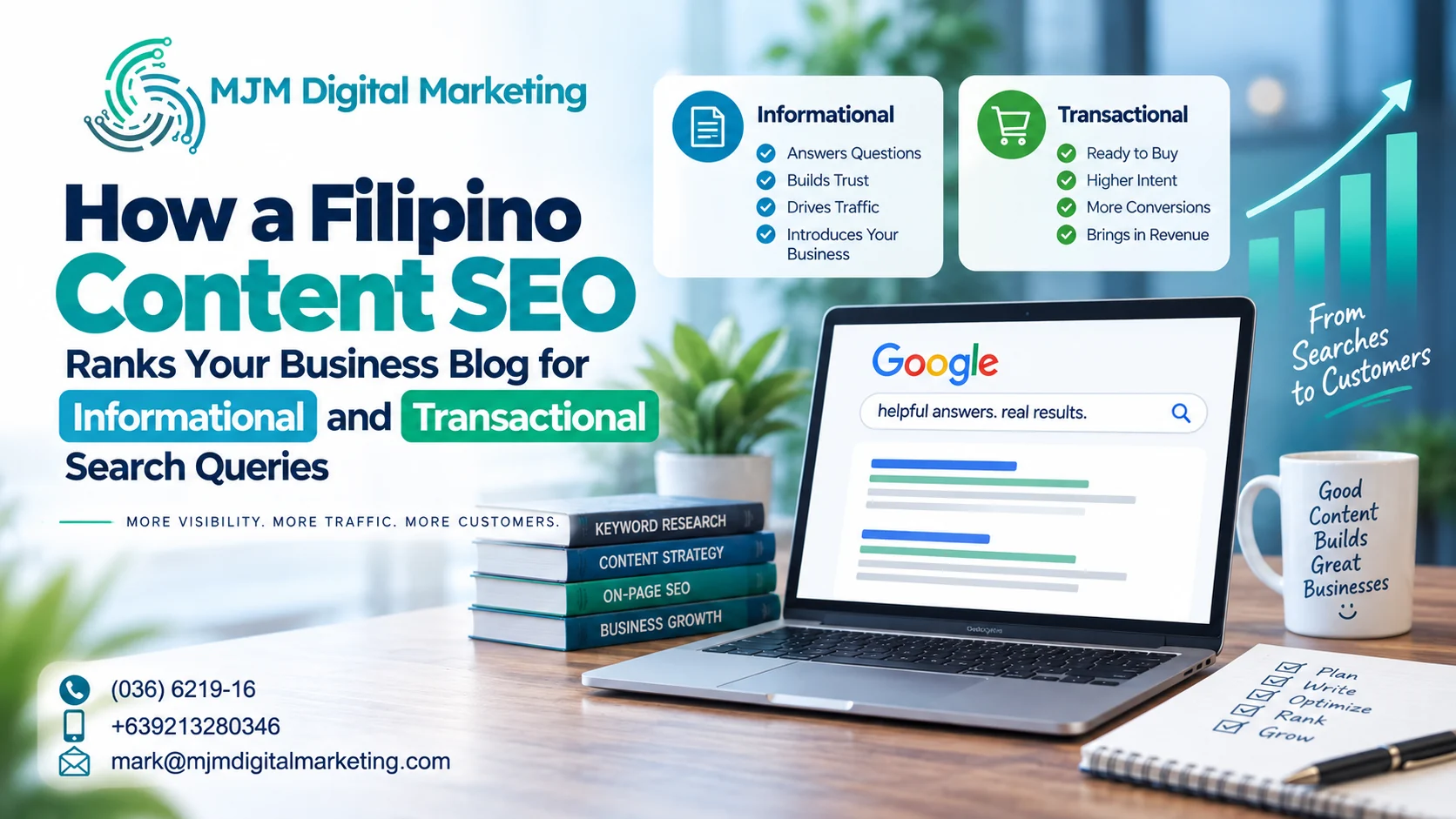
    The easiest way to understand the difference is to think about what the searcher wants to do next.

    An informational search query usually means:

    “Help me understand something.”

    A transactional search query usually means:

    “Help me take action.”

    For example:

    Informational:
    “Why does my furnace keep shutting off?”

    Transactional:
    “furnace repair Charlotte NC”

    The first searcher has a question.

    The second is looking for someone.

    Another example:

    Informational:
    “How long does Invisalign treatment take?”

    Transactional:
    “Invisalign dentist San Diego”

    Same general subject.

    Completely different moment.

    Informational Queries Build The Beginning Of The Relationship

    Informational searches are often treated as less valuable because the searcher may not be ready to buy immediately.

    I think that is short-sighted.

    Someone researching:

    “how do I know if my roof needs replacing”

    may eventually need a roofing company.

    Someone searching:

    “does a cracked tooth need a crown”

    may eventually book a dental appointment.

    Someone asking:

    “why does my septic system smell outside”

    may eventually call a septic service provider.

    The commercial opportunity is already there.

    It is simply earlier.

    Informational content allows a business to introduce itself before the customer starts comparing companies.

    That has value.

    It also creates topical depth across a website.

    Instead of having five service pages saying “hire us,” the website contains dozens of resources demonstrating that the business understands the problems surrounding those services.

    Google’s people-first content guidance asks whether readers leave feeling they have learned enough to help accomplish their goal. That is a useful standard for informational content.

    Did the article actually help?

    Or did it merely occupy a URL?

    Transactional Queries Are Closer To The Money

    Transactional searches usually have clearer commercial intent.

    Examples include:

    • dentist accepting new patients
    • AC repair near me
    • retaining wall contractor Charlotte NC
    • book dog boarding Charlotte
    • emergency plumber Rock Hill
    • SEO agency Philippines
    • Invisalign consultation San Diego

    These users are much closer to doing something.

    They may call.

    Request pricing.

    Book.

    Submit a form.

    Visit a location.

    That is why transactional keywords are highly competitive.

    Everyone wants the customer at the moment they pull out their wallet.

    But here is the interesting part.

    A strong blog strategy can support those transactional rankings indirectly.

    An article about “Why Does My AC Keep Freezing Up?” can internally link to an AC repair page.

    A guide to “When Should a Retaining Wall Be Replaced?” can support the retaining wall replacement service page.

    A post about “How Long Does Dog Boarding Take to Adjust To?” can point readers toward the boarding service.

    The informational page answers.

    The transactional page converts.

    They should be teammates, not strangers.

    How a Filipino Content SEO Ranks Your Business Blog for Informational and Transactional Search Queries middle

    How Do You Optimize Blog Content For Both Informational And Transactional Keywords?

    Trying to force both intents into one page is where SEO content occasionally gets weird.

    A writer starts with:

    “How often should you pump a septic tank?”

    Then halfway through, the article suddenly becomes:

    BEST SEPTIC PUMPING COMPANY NEAR ME CHEAP SEPTIC SERVICE CALL TODAY

    Nobody asked for that.

    The better approach is to recognize which intent owns the page while supporting the secondary intent naturally.

    Start With One Primary Search Intent

    Every article needs a main job.

    If the query is informational, answer it.

    Quickly.

    If somebody searches:

    “Can a chipped tooth heal on its own?”

    the first section should answer that question.

    Do not spend 400 words introducing teeth.

    Readers are familiar with teeth.

    Give them the answer, explain why, then explore treatment options and when professional care may be necessary.

    The business opportunity appears naturally because the topic eventually reaches a point where professional help makes sense.

    That is much better than forcing a booking pitch into sentence four.

    Build Around Follow-Up Questions

    Real searches rarely end with one question.

    Someone researching a leaking water heater may next wonder:

    • Is it dangerous?
    • Can I still use it?
    • Can the tank be repaired?
    • How much does replacement cost?
    • How long does a water heater last?
    • Who repairs water heaters near me?

    Those follow-up questions create depth.

    They also allow informational content to gradually move toward commercial intent.

    By the time the person understands that the tank may need replacement, linking to a water heater installation service no longer feels promotional.

    It feels useful.

    That is the sweet spot.

    Internal links are one of the most underappreciated parts of content SEO.

    A blog about dental implant recovery should logically connect to the dental implant service page.

    A blog about signs of septic failure should link to septic inspection or pumping services.

    An article about flickering lights might connect to an electrician’s troubleshooting or electrical repair page.

    These links help users move through the website.

    They also help search engines understand relationships between pages.

    Google explicitly recommends crawlable links so it can discover other pages across a website.

    But please, spare the reader from anchor text like:

    best affordable professional emergency electrician services Charlotte NC

    That is not a link.

    That is a cry for help.

    Natural anchor text works perfectly well.

    Match The Call To Action To The Reader’s Stage

    Not every blog needs:

    CALL NOW!!!

    Sometimes the visitor is still researching.

    The CTA might instead say:

    “Not sure whether your retaining wall needs repair or replacement? A professional inspection can help determine the extent of the problem.”

    That moves the reader forward without grabbing them by the collar.

    For someone reading an emergency plumbing article, however, a more direct CTA makes perfect sense.

    Intent should influence the conversion strategy too.

    Optimize The Transactional Pages Separately

    This is important.

    Do not expect blogs to do every job.

    A business still needs strong:

    • Service pages
    • Location pages
    • Product pages
    • Contact pages
    • Google Business Profile listings
    • Conversion-focused landing pages

    The blog supports those pages.

    It does not replace them.

    If someone searches “roofing contractor Charlotte NC,” Google may reasonably prefer a roofing company’s service or location page rather than a 2,000-word article explaining what roofers do.

    The right page type matters just as much as the keyword.

    Add Something That Wasn’t Written By Everyone Else

    This has become more important as the internet fills with interchangeable articles.

    Google’s 2026 guidance for visibility in its AI search features specifically encourages useful, non-commodity content with unique viewpoints and first-hand expertise rather than material that simply recycles information already available everywhere.

    That is good advice even if you ignore AI search completely.

    A contractor can contribute observations from actual projects.

    A dentist can explain what patients commonly misunderstand.

    An HVAC company can identify symptoms homeowners frequently overlook.

    A landscaper can discuss what actually happens in the local climate.

    That information is harder to copy because it comes from experience.

    A good Filipino content SEO knows how to pull that expertise out of the business and turn it into useful search content.

    That is far more valuable than asking an AI tool to “write 20 blogs about HVAC.”

    Why Should Businesses Hire A Filipino Content SEO Specialist For Blog Optimization?

    Cost is part of the answer.

    There is no point pretending otherwise.

    One reason international businesses hire Filipino SEO talent is that the economics can be attractive compared with building an equivalent content operation entirely in the United States, UK, Australia, or Canada.

    But I think focusing only on labor costs sells Filipino SEO professionals short.

    The more interesting advantage is exposure.

    Many Filipino content SEOs spend their careers working across international markets.

    They may write for an American dentist in the morning, research an Australian service business after lunch, optimize a British company’s page in the afternoon, and prepare reporting for another international client before finishing the day.

    That creates adaptability.

    You learn that customers do not all use the same terminology.

    You learn that local context matters.

    You learn to research industries quickly.

    You learn that a client saying “make this rank” is not actually a strategy.

    And you learn that excellent English does not simply mean correct grammar.

    It means understanding tone.

    A dental article should not sound like a roofing page.

    A lawyer should not sound like a dog daycare.

    A septic company probably does not need luxury-fashion vocabulary.

    That seems obvious, yet generic content production gets this wrong constantly.

    Filipino Content SEOs Often Sit Between Several Jobs

    A strong content SEO specialist is rarely “just the writer.”

    They are often involved in:

    • Keyword research
    • Competitor analysis
    • Search intent classification
    • Content briefs
    • On-page optimization
    • Internal linking
    • WordPress publishing
    • Search Console analysis
    • Content refreshing
    • Local SEO
    • Reporting

    That makes them useful because they can see what happens before and after the article is written.

    A traditional writer may deliver the copy and move on.

    A content SEO should ask:

    Did Google index it?

    What queries is it appearing for?

    Is it ranking on page two?

    Could the title improve?

    Does another page compete with it?

    Should we add internal links?

    Has search intent shifted?

    Can the article support an important service page?

    That feedback loop is where content SEO becomes much more valuable than simple blog production.

    The Real Skill Is Knowing When Not To Stuff Another Keyword In

    SEO content used to have an unfortunate reputation.

    You probably remember the style.

    “Are you searching for the best dentist in Dallas? Our Dallas dentist offers Dallas dentistry for Dallas dental patients looking for a dentist in Dallas.”

    Apparently, Google needed reassurance about Dallas.

    Modern content optimization should be far less clumsy.

    Google says its language-matching systems can understand how pages relate to many queries even when every possible search variation is not used word-for-word.

    That should be liberating.

    Write naturally.

    Use important terminology where it belongs.

    Cover the topic thoroughly.

    Answer related questions.

    Build logical internal links.

    Then stop.

    You do not win extra points because the exact keyword appeared 37 times.

    At MJM Digital Marketing, We Don’t Publish Blogs Just To Fill A Content Calendar

    There is a particular kind of SEO meeting nobody enjoys.

    “Did we publish four blogs this month?”

    “Yes.”

    “Did they rank?”

    “Not really.”

    “Did they support our service pages?”

    “No.”

    “Did they bring traffic?”

    “Barely.”

    “Excellent. Four more next month.”

    That is not content strategy.

    That is maintaining a blog-shaped habit.

    At MJM Digital Marketing, we believe business content should have a reason to exist.

    Sometimes that reason is capturing an informational search before the customer knows which company they need.

    Sometimes it is strengthening topical authority around an important service.

    Sometimes it is supporting a commercial page through internal links.

    Sometimes it is answering the exact question prospects repeatedly ask before they book.

    And sometimes the right decision is not publishing something new at all. It is improving the article already sitting in position 11.

    Our Filipino content SEO approach connects keyword research, search intent, useful writing, on-page optimization, internal linking, and commercial strategy so a blog can do more than increase the number beside “Posts” in WordPress.

    We want informational content to answer real questions.

    We want transactional pages to turn relevant interest into action.

    Most importantly, we want the two to work together.

    Because a person searching “why is my retaining wall leaning?” today could become the person searching “retaining wall contractor near me” next week.

    A smart content strategy does not wait until the second search to introduce the business.

    It earns attention during the first one.

    That is where a skilled Filipino content SEO specialist can make a business blog genuinely useful, both to the person reading it and to the company paying for it.

  • Why Filipino SEOs Understand Search Intent Better Than Most

    Why Filipino SEOs Understand Search Intent Better Than Most

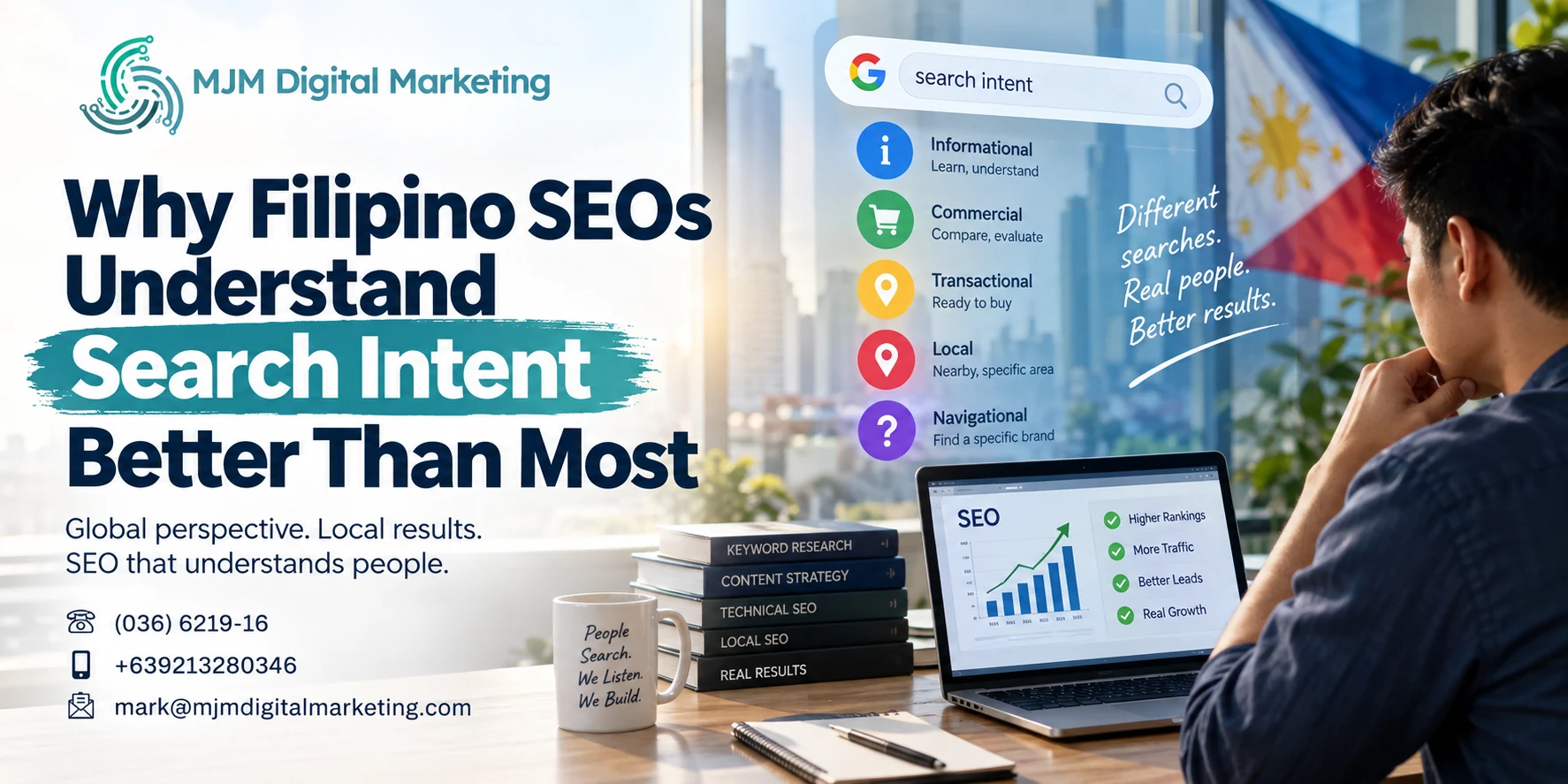
    Search intent is one of those SEO concepts that sounds simple until you actually have to use it.

    Someone types a phrase into Google. Easy enough.

    But what do they really want?

    Do they want information? A service provider? A price? A comparison? A quick answer? A company nearby? A reason to trust one business over another?

    That is where SEO becomes less about tools and more about interpretation.

    And this is one area where Filipino SEO specialists often have a real advantage.

    Not because being Filipino somehow gives someone supernatural insight into Google. Obviously not. The advantage comes from experience. Many Filipino SEOs spend years working with international businesses, writing for audiences in different countries, speaking with foreign clients, researching industries they did not grow up around, and learning how people phrase problems when they are ready to buy.

    That environment trains people to read between the lines.

    And search intent is really just that.

    The keyword is what the user typed.

    The intent is what they meant.

    A skilled Filipino SEO learns to tell the difference.

    Why Are Filipino SEO Specialists Good At Understanding Search Intent?

    One of the biggest mistakes in SEO is treating keywords as instructions.

    If a keyword says “roof repair cost,” a weak SEO approach might be:

    “Great. Put ‘roof repair cost’ in the title, heading, first paragraph, image alt text, and seven more places.”

    Technically, the keyword has been optimized.

    Strategically, almost nothing has happened.

    A better SEO asks:

    Why is the person searching for roof repair cost?

    Maybe they spotted a leak.

    Maybe a contractor gave them an estimate and they want to know whether it is fair.

    Maybe they are comparing repair versus replacement.

    Maybe they need to know whether insurance could cover storm damage.

    Maybe they are simply budgeting.

    Those possibilities matter because the best page should answer the questions surrounding the keyword, not just repeat the keyword itself.

    Filipino SEO professionals tend to get a lot of practice with this kind of interpretation because many work across multiple industries and international markets.

    One day, the client is a dentist in Texas.

    The next, it is an HVAC company in South Carolina.

    Then a law firm.

    Then an artificial turf contractor.

    Then a bookkeeping company.

    That variety forces you to stop thinking like the business and start thinking like the customer.

    A dentist may describe a procedure using a clinical term.

    The patient searches:

    “Why does my tooth hurt when I bite?”

    A contractor might call something a “segmental retaining wall system.”

    The homeowner searches:

    “Why is my retaining wall leaning?”

    An SEO who understands search intent knows that the customer’s language usually matters more than the internal language of the business.

    That is a valuable skill.

    It is also one reason the best Filipino SEOs often spend so much time looking at:

    • People Also Ask questions
    • Related searches
    • Google autocomplete
    • Competitor pages
    • Reddit discussions
    • Customer reviews
    • Search Console queries
    • Google Maps listings
    • Actual sales questions

    Those are not just keyword sources.

    They are clues.

    They show how people describe their problems when nobody has coached them on the “correct” terminology.

    And that is often where the best content ideas come from.

    What Are The Top 3 SEO Ranking Factors That Filipino Seos Focus On?

    There is no single official Google document saying, “These are the top three ranking factors, in order.”

    SEO is more complicated than that.

    Still, in practical day-to-day work, most strong Filipino SEOs tend to focus heavily on three broad areas:

    1. Relevance

    First, the page needs to deserve to rank for the query.

    That means the content has to match the searcher’s intent.

    If someone searches for “emergency plumber near me,” they probably do not want a 2,500-word blog about the history of indoor plumbing.

    They want help.

    Probably quickly.

    A page targeting that query should make practical information obvious:

    • What emergency services are available?
    • What problems are handled?
    • What areas are served?
    • Is help available after normal business hours?
    • How can the customer get in touch?
    • What should they do while waiting?

    That is relevance.

    The same principle applies to informational searches.

    If someone asks, “How long does dental implant recovery take?” the answer should appear early.

    Do not make readers dig through a ceremonial introduction about how dentistry has evolved over the centuries.

    Give them the answer.

    Then explain the details.

    2. Authority And Trust

    Google also needs reasons to believe the website is credible.

    This is where backlinks, reviews, citations, brand mentions, expertise, and reputation matter.

    A website saying:

    “We are the best roofing company in the entire universe”

    does not automatically make that statement true.

    Especially when the website has six reviews and no one else on the internet appears to have heard of the company.

    Authority grows when other signals support the business.

    That may include:

    • Customer reviews
    • Local business listings
    • Mentions from industry organizations
    • Links from relevant websites
    • Local news coverage
    • Supplier relationships
    • Professional memberships
    • Useful original content

    A good Filipino SEO looks beyond the website itself.

    SEO does not happen only inside WordPress.

    3. Technical Quality

    Finally, Google needs to be able to access and understand the website.

    This sounds obvious, yet technical problems routinely undermine perfectly good content.

    Pages might be:

    • Blocked from indexing
    • Too slow
    • Poorly linked internally
    • Duplicated
    • Redirected incorrectly
    • Missing from important navigation
    • Difficult to use on mobile
    • Competing with other pages on the same website

    The technical side is not glamorous.

    Nobody throws a party because a canonical tag was fixed correctly.

    But it matters.

    The best Filipino SEOs understand that search intent, content, and technical performance all have to work together.

    Great intent targeting on a broken website still gives you a broken website.

    What Are The 3 C’s Of SEO, And How Do They Relate To Search Intent?

    The traditional three C’s of SEO are generally described as:

    Content, Code, and Credibility.

    It is a surprisingly useful framework because almost every major SEO problem can be traced back to one of those areas.

    Content

    Content is what answers the search.

    It should match what the person wants.

    If the query is:

    “best artificial turf for dogs”

    the content should probably discuss things such as drainage, odor control, durability, cleaning, heat, blade height, and pet safety.

    It should not simply say:

    “Our artificial turf is premium quality. Contact us today.”

    That is advertising.

    Not an answer.

    Search intent should shape the page before the writing starts.

    Code

    Code is how search engines access and interpret the answer.

    A perfectly written page can still struggle if Google cannot find it or understand how it fits into the rest of the website.

    That means technical basics matter:

    • Clear page structure
    • Crawlable links
    • Correct indexation
    • Mobile usability
    • Fast loading
    • Logical URLs
    • Proper headings
    • Structured data where appropriate

    Code supports intent by making the right content easy to discover.

    Think of it this way.

    Content is the restaurant.

    Code is the road that gets you there.

    A wonderful restaurant with no road is going to have a quiet Friday night.

    Credibility

    Credibility is the reason people and search engines trust the page.

    This matters especially for topics involving health, money, law, safety, or expensive purchases.

    If someone is researching dental implants, they want information from a credible dental source.

    If they are trying to understand tax obligations, they probably do not want financial advice from a random lifestyle blogger who watched three TikToks on accounting.

    Credibility supports search intent because users are not only looking for an answer.

    They are looking for an answer they can trust.

    That distinction matters.

    A page can technically answer the question and still feel unreliable.

    The best SEO combines all three C’s.

    Useful content.

    Accessible code.

    Strong credibility.

    That is a much healthier approach than simply chasing keyword density.

    Why Filipino SEOs Understand Search Intent Better Than Most Middle

    What Is The Most Common Goal Of A Search Engine When Ranking Content?

    The basic goal is simple:

    Give users the result most likely to satisfy what they are trying to accomplish.

    That is the whole game.

    Search engines want people to keep using them.

    And people keep using search engines when the results are useful.

    If someone searches:

    “AC repair Charlotte NC”

    and Google consistently shows bicycle shops in Seattle, Google has a problem.

    If someone searches:

    “how long does a root canal take”

    and every result spends the first 1,000 words explaining the anatomy of a tooth before answering the question, the experience is not particularly good either.

    The search engine therefore tries to understand both the query and the likely intent.

    That intent can change depending on context.

    A search for:

    “best coffee”

    might mean:

    • Best coffee beans to buy online
    • Best coffee shop nearby
    • Best coffee brewing method
    • Best coffee brands
    • Best coffee for espresso

    The words alone do not tell the full story.

    This is why studying the actual search results matters.

    Google is effectively showing you what it currently believes users want.

    If almost every result is a product comparison page, that tells you something.

    If the search results are mostly local businesses, that tells you something else.

    If the page is dominated by videos, reviews, forums, or guides, those are clues too.

    Experienced Filipino SEOs often become very good at reading SERPs this way.

    Not just:

    “What ranks?”

    But:

    “Why does this type of result rank?”

    That is a much better question.

    It forces the SEO to think about format, context, user expectation, and the stage of the buying journey.

    Search intent is not a box you tick in a content brief.

    It is the reason the content exists.

    How Does The Philippines’ Call Center Industry Help Develop Strong SEO And Communication Skills?

    The Philippines’ outsourcing and call center industry has influenced professional communication in ways that reach far beyond customer support.

    Millions of Filipino professionals have worked in environments where success depends on understanding people from different cultures, accents, industries, and communication styles.

    That creates skills that transfer surprisingly well to SEO.

    One of the biggest is interpretation.

    A customer rarely describes a problem perfectly.

    They say things like:

    “My internet is acting weird.”

    “My air conditioner sounds like it is dying.”

    “My tooth hurts when I chew.”

    “There is water coming from somewhere behind the wall.”

    Customer service professionals learn not to get stuck on the exact wording.

    They ask questions.

    They infer context.

    They identify the underlying need.

    That is almost exactly what search-intent research requires.

    You Learn To Understand The Question Behind The Question

    When a person searches:

    “Why does my AC keep turning off?”

    they may technically be asking for information.

    But there may also be commercial intent underneath it.

    They want to know:

    Is this a simple problem?

    Can I fix it myself?

    Is it dangerous?

    Do I need an HVAC technician?

    How much could this cost?

    Should I repair or replace the system?

    A good SEO sees those hidden questions.

    That makes the content more useful and more commercially relevant without turning it into a sales pitch every three paragraphs.

    You Learn To Adjust Your Language

    Filipino professionals working with U.S., UK, Australian, and Canadian clients become very aware that people describe the same thing differently.

    A British customer may say “solicitor.”

    An American says “attorney.”

    Australians may use terminology that sounds completely normal locally but unfamiliar elsewhere.

    Even within the United States, phrasing changes by region.

    A good SEO cannot assume the language they personally use is the language customers search.

    They have to research.

    That cultural flexibility is useful.

    You Learn To Communicate Clearly

    SEO has become increasingly technical.

    But the best SEO specialist is not necessarily the person who can use the most jargon.

    Clients do not need to hear:

    “We identified keyword cannibalization due to overlapping semantic clusters affecting index-level relevance.”

    They need:

    “Three of your pages are competing for the same search term, so Google is unsure which one to rank. We should consolidate them.”

    Same problem.

    Much better communication.

    The Philippines’ customer-service culture encourages that kind of translation.

    Explain the problem clearly.

    Understand what the person needs.

    Do not make them feel stupid for asking.

    That is good customer service.

    It is also good SEO.

    Search Intent Is Where Good SEO Starts Feeling Human

    SEO has become incredibly data-heavy.

    We have dashboards for everything.

    Rank tracking.

    Traffic graphs.

    Crawl reports.

    Keyword databases.

    Backlink tools.

    Heatmaps.

    AI summaries.

    Competitor gap analysis.

    You can spend an entire day looking at charts and forget that every search started with a person.

    A person who needed something.

    That is why search intent matters so much.

    And it is why the strongest Filipino SEO professionals are not simply people who know how to use Ahrefs, Semrush, Screaming Frog, or Search Console.

    They understand people.

    They understand that:

    “best dentist near me”

    is not just a keyword.

    It is somebody deciding who they might trust with their health.

    “emergency plumber”

    is somebody with water spreading across the floor.

    “retaining wall repair cost”

    might be somebody staring nervously at a wall leaning toward their driveway.

    Once you think that way, SEO changes.

    You stop writing for algorithms.

    You start building pages for situations.

    That usually leads to better SEO anyway.

    At MJM Digital Marketing, we believe a keyword is only useful when we understand why someone typed it.

    Search volume matters.

    Rankings matter.

    Technical SEO matters.

    Backlinks matter.

    But those things work much better when the strategy begins with real search behavior.

    Our approach is to look beyond the keyword itself.

    We ask what the person is trying to accomplish, what questions they are likely to have next, what type of page would help them most, and what information could move them from uncertainty to action.

    That influences everything from blog topics and service pages to local SEO, internal linking, content structure, and conversion strategy.

    Filipino SEO talent has a lot to offer international businesses, but the strongest advantage is not simply lower cost.

    It is adaptability.

    It is communication.

    It is the ability to work across industries, markets, and audiences while constantly asking:

    What does the person searching actually need?

    At MJM Digital Marketing, that question is where good SEO starts.

    Because ranking for a keyword is useful.

    Understanding the human being behind it is what makes the ranking worth having.