Warning: dir(/home1/yzrieljohn02/mjmdigitalmarketing.com/wp-content/upgrade/wordpress-seo.27.6/wordpress-seo/src/dashboard/infrastructure/score-results/seo-score-results/): Failed to open directory: No such file or directory in /home1/yzrieljohn02/mjmdigitalmarketing.com/wp-admin/includes/class-wp-filesystem-direct.php on line 665
August 2026 | MJM Digital Marketing

Month: August 2026

  • Is SEO Still Worth It for Small Businesses?

    Is SEO Still Worth It for Small Businesses?

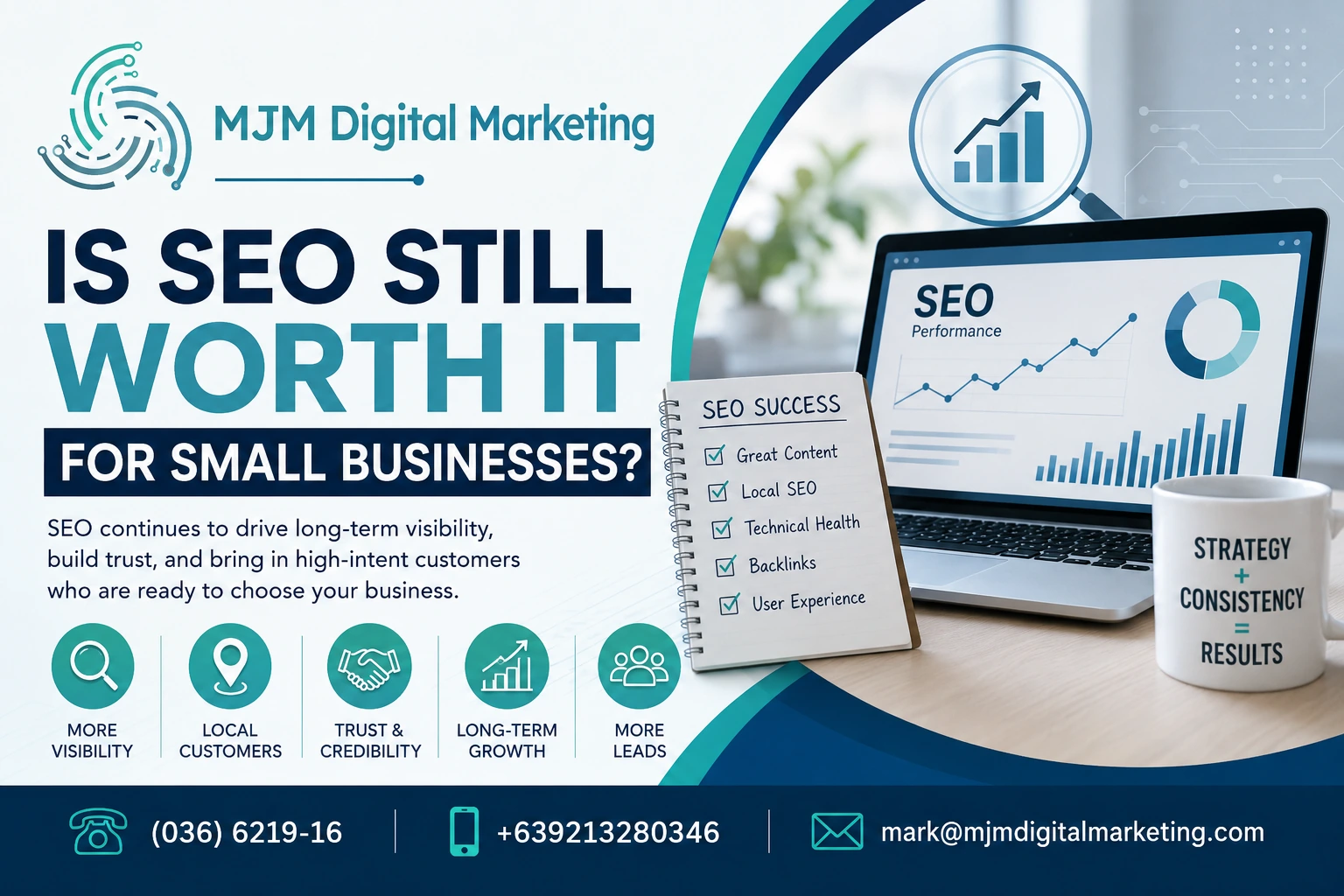
    For small businesses, every marketing dollar needs to work hard. Business owners often ask whether SEO is still worth the investment, especially with paid ads, social media, AI search tools, and constant Google updates competing for attention. The simple answer is yes. SEO is still one of the most valuable long-term marketing strategies for small businesses, but the way it works has changed.

    Today, SEO is not just about ranking for keywords. It is about building trust, answering customer questions, improving website performance, strengthening local visibility, and helping search engines understand why your business is the right choice. Whether customers find you through Google Search, Google Maps, AI Overviews, or traditional organic results, a strong SEO foundation still matters.

    Is SEO still worth it for small businesses in 2026?

    Yes, SEO is still worth it for small businesses in 2026 because customers still use search engines to find products, services, and local providers. When someone searches for “roof repair near me,” “family dentist in Columbia,” or “best HVAC company in Rock Hill,” they are often close to making a decision. Showing up for those searches can lead to calls, form submissions, appointments, and sales.

    SEO is especially valuable because it builds long-term visibility. Unlike paid advertising, where traffic stops when the budget ends, SEO can continue generating results over time. A well-optimized service page, blog, or location page can attract potential customers for months or even years if it remains useful and relevant.

    For small businesses, SEO helps with:

    • Increasing organic website traffic
    • Improving local search visibility
    • Building brand credibility
    • Generating qualified leads
    • Reducing dependency on paid ads
    • Supporting Google Business Profile performance
    • Helping customers find answers before contacting you

    The businesses that benefit most from SEO are the ones that treat it as an ongoing strategy rather than a one-time task.

    Is SEO dead, or is it continuing to evolve with AI and search updates?

    SEO is not dead. It is evolving.

    Artificial intelligence has changed how search results appear, especially with AI-generated answers and summaries. However, AI still needs reliable information from websites, business profiles, reviews, and trusted online sources. That means businesses still need optimized content, strong technical SEO, clear service information, and authority signals.

    What has changed is the quality standard. Thin content, keyword stuffing, duplicate pages, and outdated tactics are less effective than ever. Search engines are better at understanding intent, context, and usefulness.

    Modern SEO now includes:

    • Creating helpful and original content
    • Optimizing for conversational search queries
    • Improving topical authority
    • Strengthening local signals
    • Using structured data
    • Keeping websites technically healthy
    • Building brand trust across the web

    AI has not removed the need for SEO. It has made strong SEO more important because search engines and AI tools need clear, trustworthy information to reference.

    Does SEO still matter for local businesses and service-based companies?

    SEO absolutely still matters for local businesses and service-based companies. In many cases, local SEO is one of the most important marketing channels they have.

    Local customers often search with immediate intent. They may need a plumber, dentist, electrician, attorney, landscaper, roofer, or HVAC contractor quickly. If your business does not appear in local search results, Google Maps, or the local pack, those leads may go to competitors.

    Local SEO helps businesses show up when people search for services in a specific city, neighborhood, or service area.

    Important local SEO elements include:

    • A fully optimized Google Business Profile
    • Accurate business name, address, and phone number
    • Strong customer reviews
    • Local service pages
    • Location-specific content
    • Consistent citations
    • Local backlinks
    • Mobile-friendly website design

    For service-based businesses, local SEO also helps build trust before the customer calls. Reviews, photos, service descriptions, business hours, and website content all work together to influence the decision.

    mjm-seo-still-worth-it-small-businesses Middle

    How long does it take for a small business to see results from SEO?

    SEO takes time, but the timeline depends on the condition of the website, competition level, location, industry, and consistency of the strategy.

    Some small improvements, such as updating title tags, fixing technical issues, or optimizing a Google Business Profile, may create noticeable progress within a few weeks. Bigger results, such as ranking for competitive service keywords, usually take several months of consistent work.

    In general, small businesses may begin seeing early SEO movement within 3 to 6 months, while stronger and more stable results often take 6 to 12 months or longer.

    Factors that affect SEO timelines include:

    • Website age and authority
    • Quality of existing content
    • Technical website health
    • Competition in the local market
    • Strength of the backlink profile
    • Google Business Profile optimization
    • Review activity
    • Publishing consistency

    SEO should be viewed as a long-term investment. The goal is not just to get a temporary traffic spike. The goal is to build a stronger digital presence that keeps producing leads over time.

    What is the 80/20 rule in SEO, and how can small businesses use it effectively?

    The 80/20 rule, also known as the Pareto Principle, suggests that a large portion of results often comes from a smaller portion of efforts. In SEO, this means small businesses should focus on the activities most likely to create meaningful results instead of trying to do everything at once.

    For many small businesses, the highest-impact SEO tasks include:

    • Optimizing the most important service pages
    • Improving Google Business Profile performance
    • Targeting high-intent local keywords
    • Creating helpful content around customer questions
    • Earning more quality reviews
    • Fixing major technical issues
    • Building relevant local backlinks

    Instead of publishing random blogs or chasing every keyword, businesses should identify which pages and search terms are most likely to generate leads.

    For example, an HVAC company may get better results by optimizing pages for “AC repair,” “heating installation,” and “emergency HVAC service” than by writing broad content that attracts visitors outside its service area.

    The 80/20 rule helps small businesses use time and budget wisely by focusing on actions that directly support visibility, traffic, and conversions.

    What are the biggest benefits of SEO compared to paid advertising for small businesses?

    SEO and paid advertising can both be valuable, but they work differently.

    Paid advertising can generate visibility quickly, but it requires ongoing spend. Once the budget stops, the traffic usually stops too. SEO takes longer to build, but it can create lasting visibility and long-term value.

    Some of the biggest benefits of SEO include:

    Long-Term Growth

    SEO builds digital assets over time. Optimized pages, blogs, and local listings can continue attracting visitors without paying for every click.

    Higher Trust

    Many users trust organic search results and local map listings because they feel more natural than ads. Strong organic visibility can make a business appear more credible.

    Cost Efficiency Over Time

    Although SEO requires investment, the cost per lead can become more efficient as rankings, content, and authority improve.

    Better Local Visibility

    Local SEO helps businesses appear in Google Maps, local packs, and location-based searches, which are especially important for service-area businesses.

    Stronger Brand Presence

    When your business appears across search results, maps, reviews, and helpful content, customers become more familiar with your brand.

    Paid ads can support fast lead generation, but SEO helps create a more stable foundation. For many small businesses, the best strategy is using both together while building long-term organic visibility.

    A Smarter Way to Build Long-Term Search Visibility

    SEO is still worth it for small businesses because customers are still searching, comparing, and making decisions online. The tools may change, and search results may look different, but the need for trust, relevance, authority, and helpful content remains strong.

    At MJM Digital Marketing, we help small businesses build SEO strategies designed for long-term growth. We focus on improving local visibility, strengthening website content, optimizing technical performance, and helping businesses attract the right customers through search. With the right strategy, SEO can remain one of the most reliable ways to generate leads, build credibility, and grow your business in 2026 and beyond.

  • How to Hire an SEO Specialist in the Philippines (2026 Guide)

    How to Hire an SEO Specialist in the Philippines (2026 Guide)

    If your website isn’t showing up on Google for the terms your customers are actually searching, the problem usually isn’t your product — it’s your SEO. And increasingly, businesses in the US, UK, Canada, and Australia are solving that problem by hiring an SEO specialist in the Philippines.

    This guide walks through why that’s become such a common move, what to actually look for when hiring, what it costs, and the questions that separate a specialist worth paying from one who’ll waste your budget.

    Why Businesses Hire SEO Specialists in the Philippines

    The Philippines has spent over a decade building a reputation as one of the world’s top destinations for digital outsourcing — and SEO is one of the areas where that reputation is best earned.

    Cost efficiency without sacrificing quality. A skilled SEO specialist in the Philippines typically costs a fraction of an equivalent hire in the US, UK, or Australia, while working with the same tools (Ahrefs, SEMrush, Moz, Google Search Console) and following the same best practices as any Western agency.

    English proficiency and cultural alignment. The Philippines consistently ranks among the top English-speaking countries in Asia, which removes a lot of the friction that can come with offshore work — briefs get understood correctly the first time, and reporting doesn’t need translation.

    Timezone overlap for real-time collaboration. Depending on where you’re based, there’s enough working-hours overlap for live calls, not just async updates — which matters when SEO work involves ongoing strategy conversations, not just task lists.

    A mature, experienced talent pool. SEO as a discipline has been practiced professionally in the Philippines since the late 2000s, so there’s now a deep bench of specialists and agencies with over a decade of hands-on experience across industries.

    What an SEO Specialist Actually Does

    Before you hire, it helps to know what’s actually inside the job description. A competent SEO specialist should be able to handle:

    • Technical and on-page SEO — site speed, crawlability, indexing, mobile-friendliness, structured data/schema markup, keyword targeting, title tags, meta descriptions, header structure, internal linking
    • Content strategy — identifying keyword opportunities and building content (blog posts, pillar pages, service pages) around them
    • Off-page SEO / link building — earning backlinks and citations that build domain authority
    • Local SEO — Google Business Profile optimization, citations, and location-based ranking factors, if you serve a specific area
    • Lead generation — turning the traffic SEO brings in into qualified leads through conversion-focused pages
    • Reporting and analytics — tracking rankings, organic traffic, and conversions, and explaining what the numbers mean in plain language

    If a candidate can only speak confidently about one or two of these, they’re a specialist in a narrow slice of SEO — which might still be useful, but you should know that going in.

    SEO Specialist vs. SEO Agency: Which Should You Hire?

    This is one of the first forks in the road, and there’s no universally right answer — it depends on your size and needs.

    An individual freelance specialist tends to be a good fit if you’re a small business with a defined, narrower scope — for example, you mainly need on-page and local SEO fixed up. You get direct access to the person doing the work, and pricing is usually lower.

    An agency tends to make more sense once you need multiple disciplines running in parallel — technical fixes, ongoing content production, and link building all happening at once — or if you want redundancy so the work doesn’t stall if one person is unavailable. This is also the better route if you’re an agency yourself looking to white-label SEO fulfillment rather than build an in-house team.

    A useful middle ground: some agencies operate with a “senior-level single point of contact” model, where you get the accountability and breadth of an agency without losing the direct access of working with one expert.

    What SEO Services Should Cost in the Philippines

    Pricing varies widely based on scope, but as a general guide:

    • Freelance specialists typically charge less than agency retainers, often with flexible or project-based pricing
    • Agency retainers usually scale with the size of the engagement — a small local business audit-and-fix project costs meaningfully less than an ongoing multi-channel campaign for a growing e-commerce brand
    • One-time audits are a lower-commitment way to test a working relationship before signing a longer retainer

    Be cautious of any quote that seems dramatically cheaper than everything else you’ve seen — SEO is one of the easiest services to fake short-term, and a rock-bottom price often means shortcuts (spammy link building, thin AI-generated content) that can get your site penalized later.

    8 Questions to Ask Before You Hire

    1. Can you show me real case studies or ranking results, not just testimonials? Ask for specifics — target keywords, timeframe, and traffic or ranking movement.
    2. What tools do you use for research and reporting? Ahrefs, SEMrush, Moz, and Google Search Console/Analytics are the industry standard — vague answers here are a red flag.
    3. How do you approach link building? Anyone promising hundreds of backlinks fast is likely using tactics that risk a Google penalty.
    4. What does your reporting look like, and how often will I get it? You want clear, jargon-free monthly reporting, not a dashboard you have to interpret yourself.
    5. How do you handle technical SEO issues? A specialist who can’t speak to site speed, crawl errors, or mobile usability is missing a core piece of the discipline. If your site has actually dropped in rankings, ask specifically about their Google ranking recovery process.
    6. What’s your content process? Ask who actually writes it, how topics are chosen, and how it ties back to keyword strategy.
    7. How do you measure success beyond rankings? Rankings that don’t convert to traffic or leads aren’t worth much — a good specialist ties SEO to business outcomes.
    8. What happens if results are slower than expected? SEO is a long game; anyone guaranteeing #1 rankings in 30 days is not being straight with you.

    Red Flags to Watch For

    • Guarantees of specific rankings or timelines (no one controls Google’s algorithm)
    • Reluctance to share past client results or references
    • Pricing far below the market average with no clear explanation
    • Vague answers about how they’ll build links or produce content
    • No mention of technical SEO at all — a sign the “specialist” only does surface-level keyword stuffing

    Getting Started

    The lowest-risk way to start is with a free SEO audit or a small initial project — it lets you evaluate communication, expertise, and reporting quality before committing to a longer engagement. From there, you can scale up to an ongoing retainer once you’ve seen how the specialist actually works, not just how they pitch.

    Hiring an SEO specialist in the Philippines can be one of the most cost-effective moves you make for long-term organic growth — as long as you go in knowing what to ask and what a real, credible answer sounds like. You can read more about our team’s approach and experience here, or browse our blog for more SEO guides like this one.

  • How to Turn Website Visitors Into Paying Customers

    How to Turn Website Visitors Into Paying Customers

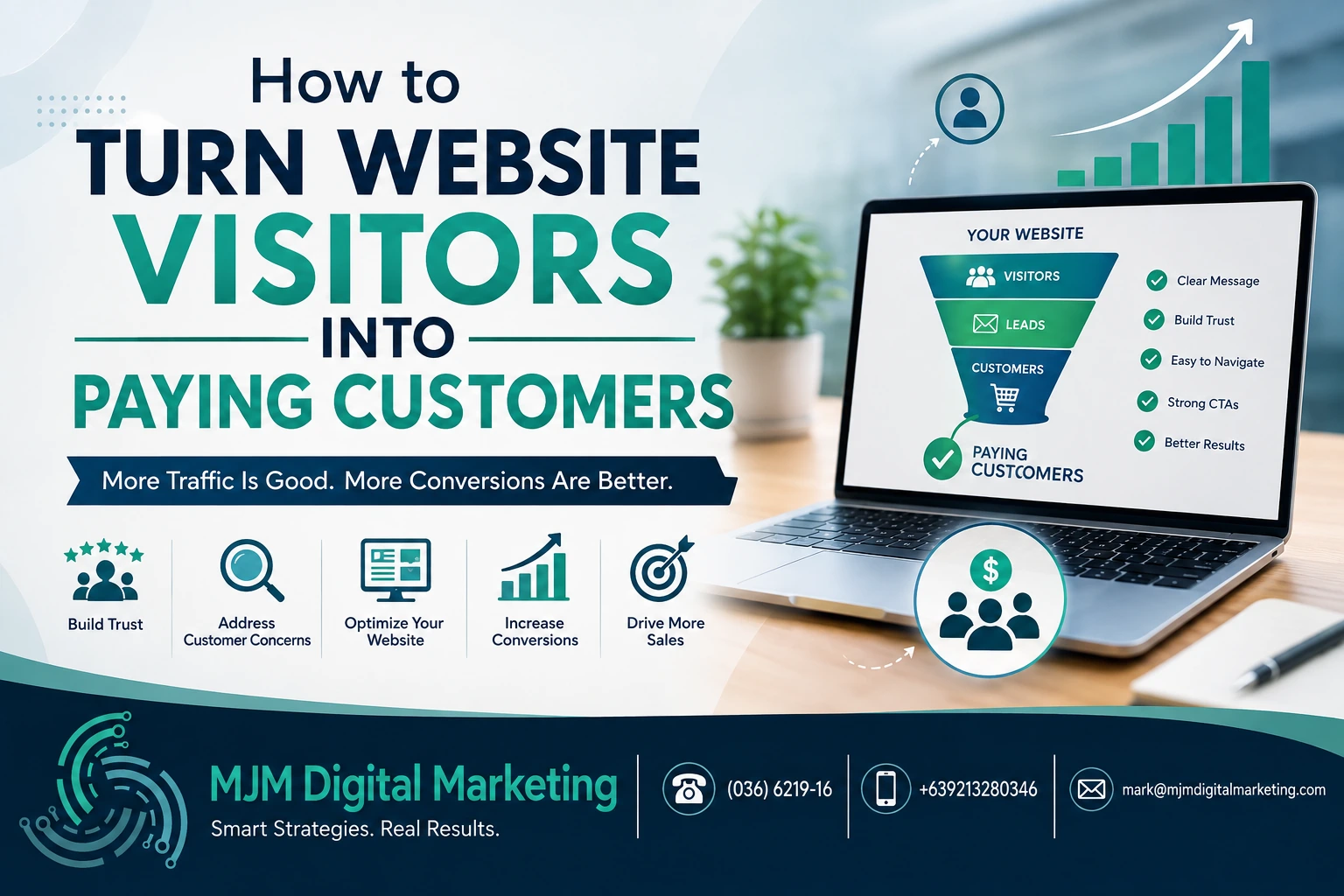
    Driving traffic to your website is only half the battle. Many businesses invest heavily in SEO, paid advertising, social media marketing, and content creation to attract visitors, but traffic alone does not guarantee revenue. The real goal is turning those visitors into paying customers.

    A website should function as more than an online brochure. It should guide users through a journey that builds trust, answers questions, removes obstacles, and encourages action. Whether you run a local service business, eCommerce store, professional practice, or B2B company, improving conversions can significantly increase your return on investment without increasing traffic.

    The good news is that converting visitors into customers often comes down to understanding user behavior and making strategic improvements throughout your website.

    How can you convert website visitors into paying customers?

    Converting website visitors into paying customers begins with understanding what visitors need before they are ready to buy. Most people do not arrive on a website prepared to make an immediate purchase. They often have questions, concerns, and comparisons to make before deciding.

    Successful websites focus on building confidence at every step.

    Some proven ways to improve conversions include:

    • Clearly communicating your products or services.
    • Highlighting your unique value proposition.
    • Displaying customer reviews and testimonials.
    • Making contact information easy to find.
    • Creating simple and intuitive navigation.
    • Providing clear next steps.
    • Removing unnecessary distractions.

    Visitors should quickly understand:

    • What you offer.
    • How it benefits them.
    • Why they should choose your business.
    • How they can get started.

    When these answers are easy to find, visitors are more likely to move forward and become customers.

    What are the most effective ways to turn browsing visitors into buyers?

    Many website visitors are interested in what you offer but need additional reassurance before taking action. The key is creating an experience that encourages trust and reduces hesitation.

    Build Trust Immediately

    Trust is one of the biggest factors influencing purchasing decisions. Visitors often decide within seconds whether a business appears credible.

    You can build trust by displaying:

    • Customer reviews.
    • Case studies.
    • Certifications.
    • Awards.
    • Industry affiliations.
    • Before-and-after examples.
    • Real team photos.

    Social proof demonstrates that other people have successfully worked with your business and achieved positive results.

    Address Customer Concerns

    Many buyers hesitate because they have unanswered questions. Frequently Asked Questions (FAQ) sections can help address concerns before they become barriers.

    Common questions may include:

    • How much does it cost?
    • How long does the process take?
    • What happens next?
    • What guarantees are available?
    • Why should I choose this company?

    Providing answers proactively helps visitors feel more comfortable moving forward.

    Create Strong Service and Product Pages

    Every page should clearly explain benefits, features, and outcomes. Instead of focusing solely on what you do, explain how your service or product solves customer problems.

    People are often more interested in results than technical details.

    How do you increase website conversion rates and generate more sales?

    Improving conversion rates often produces greater returns than simply increasing website traffic. If more visitors take action, your business can generate more leads and sales from the same amount of traffic.

    One effective strategy is simplifying the conversion process.

    Ask yourself:

    • Is it easy to contact your business?
    • Can visitors find pricing information?
    • Are forms too long?
    • Are important buttons easy to see?

    Complicated processes often create friction that causes users to leave.

    Additional conversion strategies include:

    Speed Optimization

    A slow website can frustrate visitors and increase abandonment rates. Faster websites typically provide better user experiences and support higher conversion rates.

    Mobile Optimization

    A significant portion of website traffic now comes from mobile devices. Every page should function smoothly across smartphones and tablets.

    Personalized Messaging

    Content that speaks directly to customer needs often performs better than generic marketing messages. Understanding your audience allows you to create more relevant experiences.

    Landing Page Optimization

    Dedicated landing pages focused on a single offer or service can improve conversion rates by eliminating distractions and directing attention toward one action.

    Small improvements across multiple areas often create significant increases in leads and sales over time.

    How to Turn Website Visitors Into Paying Customers Middle

    What website design elements help convert visitors into customers?

    Website design influences how users perceive your business and whether they feel comfortable taking action.

    Good design is not only about appearance. It is about usability, clarity, and guiding visitors toward a goal.

    Clear Navigation

    Visitors should be able to find important information quickly. Complicated menus and cluttered layouts often create confusion.

    Professional Visuals

    High-quality photos, videos, and graphics contribute to a professional appearance and help establish credibility.

    Strategic Layout

    Important information should appear prominently on the page. Visitors should not need to search extensively for service details, contact information, or calls-to-action.

    Readable Content

    Large blocks of text can overwhelm visitors. Breaking content into sections with headings, bullets, and short paragraphs improves readability.

    Trust Signals

    Design elements that reinforce credibility include:

    • Customer testimonials.
    • Review ratings.
    • Industry certifications.
    • Security badges.
    • Partner logos.
    • Awards and recognitions.

    These elements help reassure visitors that they are making a safe and informed decision.

    Why do website visitors leave without making a purchase, and how can you prevent it?

    Many businesses focus on attracting visitors but overlook the reasons visitors leave without converting.

    Common reasons include:

    Lack of Trust

    If visitors are unsure about a company’s credibility, they may leave to continue researching competitors.

    Poor User Experience

    Confusing navigation, slow load times, and difficult-to-use forms can frustrate users and cause abandonment.

    Unclear Value Proposition

    Visitors need to understand why your business is the best solution. If your message is vague or generic, they may lose interest.

    Too Many Distractions

    Excessive pop-ups, unnecessary links, or cluttered layouts can overwhelm visitors and pull attention away from important actions.

    Missing Information

    Customers often leave when they cannot find answers to key questions regarding pricing, services, timelines, or policies.

    To reduce abandonment:

    • Improve page speed.
    • Simplify navigation.
    • Provide clear information.
    • Add social proof.
    • Use stronger calls-to-action.
    • Make contacting your business easy.

    The easier it is for visitors to move forward, the more likely they are to convert.

    How can calls-to-action (CTAs) and user experience influence customer conversions?

    Calls-to-action and user experience work together to guide visitors toward becoming customers.

    A call-to-action tells visitors exactly what to do next. Without clear direction, users may leave even if they are interested in your services.

    Examples of effective CTAs include:

    • Request a Free Consultation
    • Schedule an Appointment
    • Get a Free Estimate
    • Contact Our Team Today
    • Start Your Project

    Strong CTAs are:

    • Visible.
    • Action-oriented.
    • Easy to understand.
    • Relevant to the page content.

    User experience plays an equally important role. Even the strongest CTA may fail if visitors encounter obstacles along the way.

    A positive user experience includes:

    • Fast-loading pages.
    • Mobile responsiveness.
    • Clear navigation.
    • Logical page structure.
    • Accessible contact options.

    When visitors enjoy their experience and know exactly what action to take, conversion rates typically improve.

    Turn More Clicks Into Customers With a Smarter Digital Strategy

    Generating website traffic is valuable, but real business growth happens when visitors become customers. By improving trust signals, simplifying user experiences, strengthening calls-to-action, and optimizing website design, businesses can increase conversions without necessarily increasing traffic.

    At MJM Digital Marketing, we help businesses create websites and digital marketing strategies that do more than attract visitors. We focus on improving user experience, increasing conversion rates, and turning online traffic into measurable business results. Through strategic SEO, website optimization, and conversion-focused marketing, we help businesses maximize every opportunity to turn website visitors into paying customers.

  • The Biggest SEO Mistakes Small Businesses Make

    The Biggest SEO Mistakes Small Businesses Make

    Search engine optimization remains one of the most effective ways for small businesses to attract customers online. When done correctly, SEO can increase website traffic, generate qualified leads, improve brand visibility, and help businesses compete against larger competitors. However, many small businesses struggle to achieve results because they unknowingly make SEO mistakes that limit their online growth.

    The good news is that most SEO problems are fixable. By understanding the most common mistakes and implementing proven strategies, businesses can improve their search visibility and create a stronger foundation for long-term success.

    What are the most common SEO mistakes small businesses make?

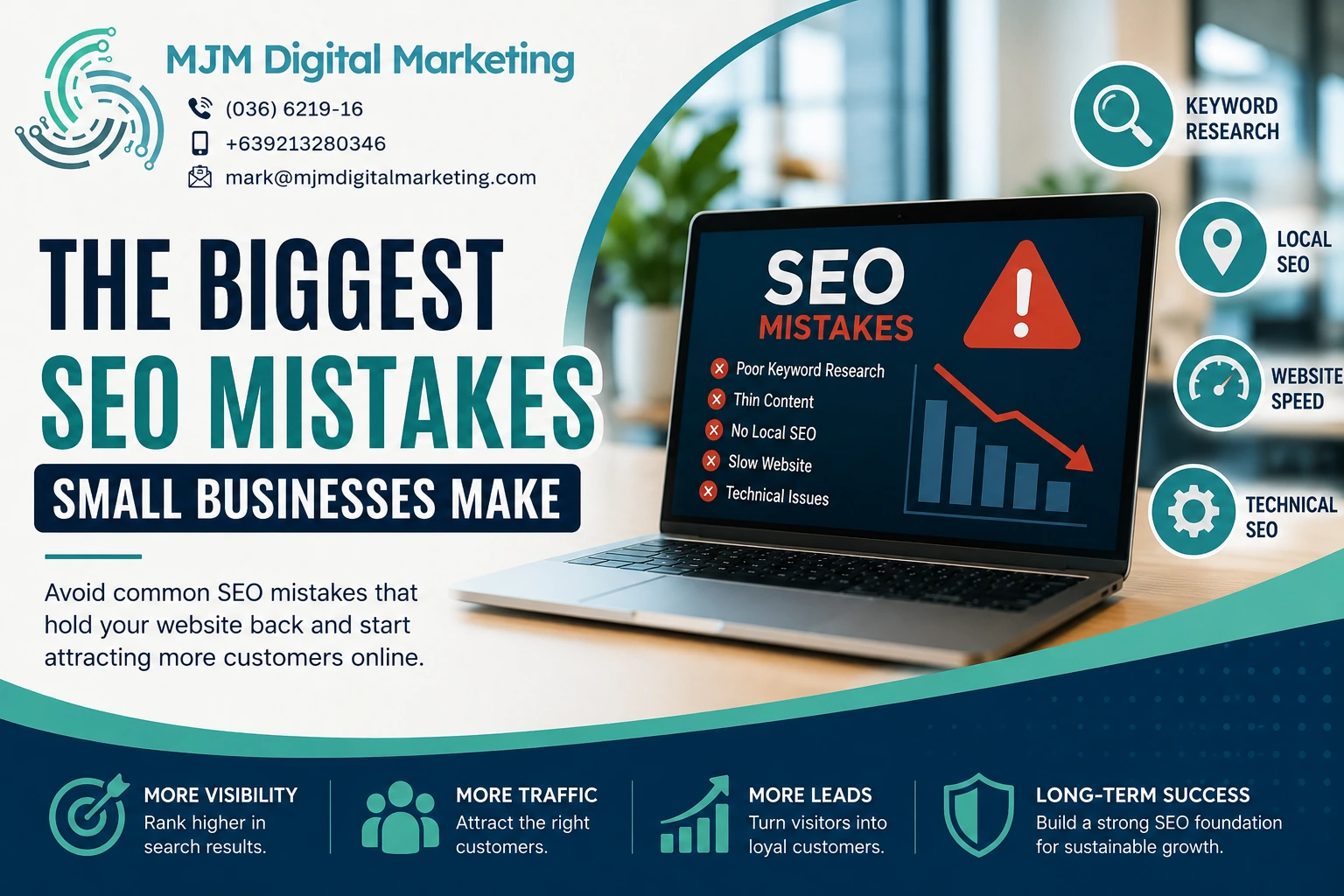
    Many small businesses invest in websites and marketing efforts but overlook critical SEO fundamentals. These mistakes can prevent a website from reaching its full potential in search results.

    Some of the most common SEO mistakes include:

    • Ignoring keyword research.
    • Creating thin or low-quality content.
    • Neglecting local SEO optimization.
    • Failing to optimize title tags and meta descriptions.
    • Using duplicate content across multiple pages.
    • Ignoring technical SEO issues.
    • Not optimizing for mobile users.
    • Having slow website loading speeds.
    • Inconsistent business information online.
    • Rarely updating website content.

    Many business owners assume that simply having a website will generate traffic. In reality, search engines need clear signals that help them understand what a business offers, where it operates, and why it deserves to rank.

    Successful SEO requires ongoing attention and a strategy that aligns with both user needs and search engine guidelines.

    Why is my small business website not ranking on Google?

    If your website is not ranking well on Google, there is rarely a single cause. Rankings are influenced by hundreds of factors, and even small issues can affect performance.

    One common reason is a lack of authority. New websites often struggle to rank because search engines have not yet established trust in the domain. Businesses must consistently build authority through quality content, backlinks, reviews, and positive user engagement.

    Another reason may be weak content. Search engines want to provide users with the best answers possible. If competitors have more comprehensive, useful, and informative content, they are more likely to rank higher.

    Your website may also suffer from:

    Poor On-Page Optimization

    Missing title tags, weak headings, or poorly optimized service pages make it harder for Google to understand your content.

    Limited Content

    A website with only a few pages often struggles to compete against businesses that regularly publish helpful content.

    Weak Local Signals

    For businesses serving specific cities or regions, local relevance is essential. Without optimized location pages, Google Business Profile optimization, and local citations, visibility may suffer.

    Technical Problems

    Issues such as broken links, crawl errors, slow load times, and indexing problems can prevent pages from ranking effectively.

    Identifying the root causes of poor rankings often requires a complete SEO audit to uncover hidden opportunities and challenges.

    The Biggest SEO Mistakes Small Businesses Make Middle

    How does poor keyword research affect SEO performance?

    Keyword research is the foundation of every successful SEO campaign. Without it, businesses may target the wrong audience or create content that never attracts meaningful traffic.

    Many small businesses make the mistake of selecting keywords based on assumptions rather than actual search behavior. As a result, they often target phrases that are either too competitive or irrelevant to their services.

    For example, a local HVAC company might focus solely on a broad keyword like “air conditioning” instead of more targeted searches such as:

    • AC repair near me
    • Emergency HVAC service
    • Air conditioner replacement in Charlotte
    • Residential HVAC maintenance

    Poor keyword research can lead to:

    • Lower search visibility.
    • Reduced website traffic.
    • Higher bounce rates.
    • Fewer qualified leads.
    • Missed local opportunities.

    Effective keyword research helps businesses understand what potential customers are searching for, the questions they are asking, and the services they need. This allows content to be created around real customer intent rather than guesswork.

    Can technical SEO issues hurt my website rankings?

    Yes. Technical SEO issues can significantly impact website rankings, even when content is strong.

    Technical SEO helps search engines crawl, understand, and index your website efficiently. If technical problems exist, search engines may struggle to access important pages or interpret site content correctly.

    Some common technical SEO issues include:

    Slow Website Speed

    Visitors expect websites to load quickly. Slow pages create poor user experiences and can negatively affect rankings.

    Mobile Usability Problems

    Most searches now occur on mobile devices. A website that performs poorly on smartphones may lose visibility and potential customers.

    Broken Links

    Broken internal and external links create frustration for users and signal maintenance issues to search engines.

    Crawl and Indexing Errors

    If search engines cannot properly crawl your website, valuable pages may never appear in search results.

    Missing Structured Data

    Schema markup helps search engines better understand your business, services, reviews, and content.

    Technical SEO often works behind the scenes, but it plays a critical role in overall website performance. Regular audits help identify issues before they impact rankings and traffic.

    Why is local SEO important for small businesses?

    For businesses that serve customers within a specific geographic area, local SEO is one of the most valuable marketing strategies available.

    When people search for services nearby, they often have strong purchasing intent. Searches such as “dentist near me,” “plumber in Columbia,” or “roof repair in Rock Hill” typically indicate that a customer is ready to take action.

    Local SEO helps businesses appear in:

    • Google Maps results.
    • Google’s Local Pack.
    • Local organic search results.
    • Voice search results.
    • Mobile searches.

    Strong local SEO includes:

    Google Business Profile Optimization

    A complete and active Google Business Profile increases visibility and improves customer engagement.

    Review Management

    Customer reviews build trust and support local ranking signals.

    Local Content Creation

    Location-specific service pages and blogs help search engines connect businesses with local customers.

    Citation Consistency

    Accurate business information across directories strengthens credibility and trust.

    Without a strong local SEO strategy, businesses may lose valuable opportunities to competitors who have invested in their online presence.

    How often should small businesses update their website content for SEO?

    Website content should be viewed as a living asset rather than a one-time project.

    Search engines favor websites that remain active, relevant, and helpful to users. While there is no universal schedule, businesses should update content regularly to maintain strong SEO performance.

    A good approach includes:

    Monthly Content Reviews

    Evaluate important pages to ensure information remains accurate and current.

    Quarterly Content Updates

    Refresh older blogs, service pages, and FAQs with updated information, statistics, or customer insights.

    Ongoing Blog Publishing

    Adding new content consistently helps expand keyword visibility and demonstrate industry expertise.

    Annual SEO Audits

    A full SEO review helps identify outdated content, technical issues, and new optimization opportunities.

    Regular updates signal to search engines that a website remains active and committed to providing valuable information. Businesses that consistently improve their content often maintain stronger rankings over time.

    Build a Stronger SEO Foundation for Long-Term Success

    SEO success is rarely determined by a single tactic. Instead, it comes from avoiding common mistakes while consistently improving content, technical performance, local visibility, and user experience. Small businesses that invest in a comprehensive SEO strategy are often rewarded with higher rankings, more website traffic, and increased lead generation.

    At MJM Digital Marketing, we help businesses identify and correct the SEO issues that may be holding their websites back. We focus on creating customized strategies that improve search visibility, strengthen local presence, and generate measurable results. By addressing common SEO mistakes and implementing proven optimization techniques, we help businesses build a stronger online foundation for long-term growth and success.